

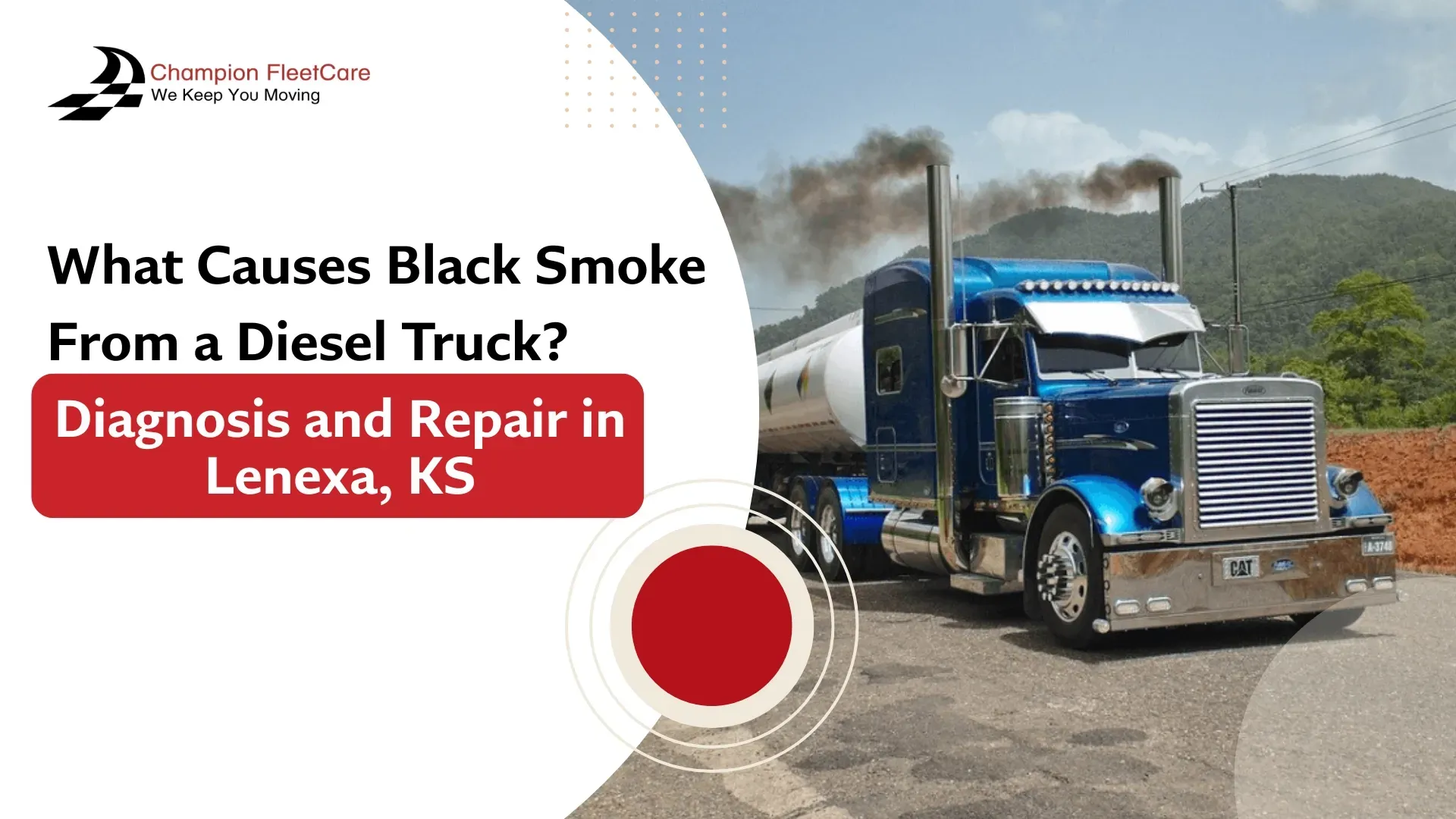
A puff of smoke under load can catch your eye. Steady black smoke from a diesel truck in Lenexa, KS, is a sign the engine is not burning fuel cleanly. That can indicate wasted fuel, weak power, excessive soot, after-treatment stress, and possible downtime. Champion FleetCare provides diesel engine repair, diagnostics, emissions support, and fleet service for trucks that need to stay productive around Lenexa and the Kansas City metro.

Why Black Smoke From a Diesel Truck in Lenexa KS Should Not Be Ignored
Black smoke usually points to an air and fuel imbalance. The engine may be getting too much fuel, too little air, poor boost pressure, or inaccurate sensor data. On newer diesel trucks, smoke can also connect to after-treatment issues that affect performance and compliance.
Too much fuel and not enough air
Diesel engines need the right fuel mixture and airflow to burn cleanly. If too much fuel enters the cylinders, or the engine cannot pull in sufficient air, the extra fuel can leave as dark soot from the exhaust. That is one reason a proper diesel truck black smoke diagnosis should look beyond the tailpipe and check how the whole system is working.
Injector issues that affect combustion
Diesel injector problems can cause poor spray patterns, over-fueling, rough running, hard starts, fuel smell, and black exhaust smoke. A sticking or leaking injector may send more fuel than the cylinder can burn cleanly. Left alone, that can raise fuel costs and put extra stress on engine parts.
Turbocharger or boost pressure problems
Many commercial diesel trucks rely on turbo boost to move sufficient air into the engine under load. If the turbocharger, charge air cooler, clamps, hoses, or related sensors fail, the truck may smoke during acceleration or while climbing grades. A route near I-435, I-35, or K-10 can make that power loss obvious when the vehicle is loaded.
Restricted air intake or dirty filters
A dirty air filter or restricted intake can choke the engine. Dust from job sites, construction routes, and industrial yards around Johnson County can accumulate faster than drivers expect. If the engine cannot breathe, it may burn fuel poorly and leave black smoke behind.
DPF and after-treatment concerns
A diesel particulate filter is designed to trap soot before it exits the exhaust. If a truck is showing heavy smoke, frequent regens, warning lights, or power reduction, the after-treatment system needs attention. DPF cleaning in Lenexa KS may help when the filter is restricted and still serviceable, but the root cause should be checked so the problem does not return.
What Black Smoke Can Mean for Local Fleet Operations
For owner-operators and fleet managers, black smoke is more than a visual issue. It can point to a truck that is using extra fuel, running inefficiently, or heading toward a larger repair.
Power loss during daily routes
A truck that smokes under the throttle may also struggle with acceleration, towing, or loaded starts. That can affect contractors, delivery fleets, utility vehicles, and service trucks moving through Lenexa, Olathe, Overland Park, Shawnee, and nearby job sites.
Fuel waste and preventable downtime
Over-fueling can burn through diesel fast. It can also create soot buildup that affects the intake, EGR system, turbocharger, sensors, and after-treatment components. Fast diesel engine repair in Lenexa KS can help limit damage before the truck ends up sidelined.
Inspection and emissions concerns
Black smoke can raise questions during roadside inspections, fleet audits, or emissions-related service checks. For commercial vehicles, staying ahead of smoke complaints helps protect driver confidence, compliance readiness, and your company’s professional image.
How Diesel Smoke Problems Are Diagnosed
Guessing at diesel smoke problems can waste money. Replacing parts without testing may leave the real issue untouched, especially on electronically controlled engines.
Scan data and fault codes
Modern diesel trucks often store useful fault codes and live data. A technician may check fuel pressure, boost readings, EGR operation, exhaust temperature, sensor inputs, and regeneration history. That information helps narrow the cause instead of treating black smoke as a single-part failure.
Air, fuel, and boost testing
Smoke diagnosis often includes checking the intake path, air filter, turbo system, charge air piping, fuel delivery, injectors, and engine control inputs. If the truck only smokes under load, testing needs to match the way the vehicle is actually used.
Exhaust and after-treatment checks
A complete inspection may include the DPF, sensors, exhaust leaks, regen performance, backpressure, and related emissions components. Champion FleetCare supports fleet diesel repair in the Kansas City metro with both in-shop and mobile service options when the situation allows.
Takeaways
Black smoke is usually a sign that fuel is not burning cleanly. The cause may be injector trouble, low boost, restricted airflow, sensor issues, EGR concerns, or after-treatment problems.
For local fleets, early diagnosis protects fuel economy, uptime, inspection readiness, and engine health. The sooner the smoke is traced to the real cause, the easier it is to keep your truck working instead of waiting for a breakdown.
Frequently Asked Questions
Is black smoke from a diesel truck always serious?
Black smoke should always be checked, especially if it is heavy, repeated, or paired with power loss. A small puff under hard acceleration may not imply the same thing as constant smoke, but ongoing black smoke usually points to poor combustion or system trouble.
Can a dirty air filter cause black smoke?
Yes, a restricted air filter can limit airflow and make the engine burn fuel less cleanly. Trucks working near dusty job sites, yards, and construction areas may need air filters inspected more often.
Can bad injectors cause black smoke?
Yes, bad injectors can over-fuel the engine or spray fuel unevenly. That can cause black smoke, rough running, hard starting, higher fuel use, and possible engine damage if ignored.
Does black smoke mean the DPF is bad?
Black smoke does not always mean that the DPF is bad. Black smoke can come from engine, air, fuel, turbo, EGR, sensor, or after-treatment issues. The DPF may be restricted or affected, but the underlying cause needs to be diagnosed before deciding on cleaning or replacement.
Should I keep driving a truck that is smoking?
If the smoke is heavy, the truck is losing power, or warning lights are on, it is better to schedule service. The same applies if the vehicle is in derate before continuing normal routes. Driving too long can increase repair costs and downtime.
Clear Up Diesel Smoke Problems With Champion FleetCare
If you are seeing black smoke from a diesel truck in Lenexa KS, Champion FleetCare can help find the cause and recommend the right repair path. Our team works with commercial trucks, fleet vehicles, owner-operators, and service vehicles that need clear answers and dependable turnaround.
Call (913) 498-9999 to schedule diesel diagnostics, or visit Champion FleetCare at 13711 W 107th St, Lenexa, KS 66215. We serve Lenexa, Johnson County, and surrounding Kansas City metro communities with diesel repair, emissions service, DPF support, fleet maintenance, and mobile service when appropriate.